
Who Is Responsible for Maintaining My Retention Pond? (Upstate SC Guide)
If you’ve ever looked at a retention pond in your neighborhood or commercial property and wondered, “Who’s actually responsible for this?” — you’re not alone.
In the Upstate of South Carolina, especially around Greenville County, this is one of the most misunderstood parts of property ownership and management. And getting it wrong can lead to violations, costly repairs, and long-term damage.
Let’s break it down clearly.
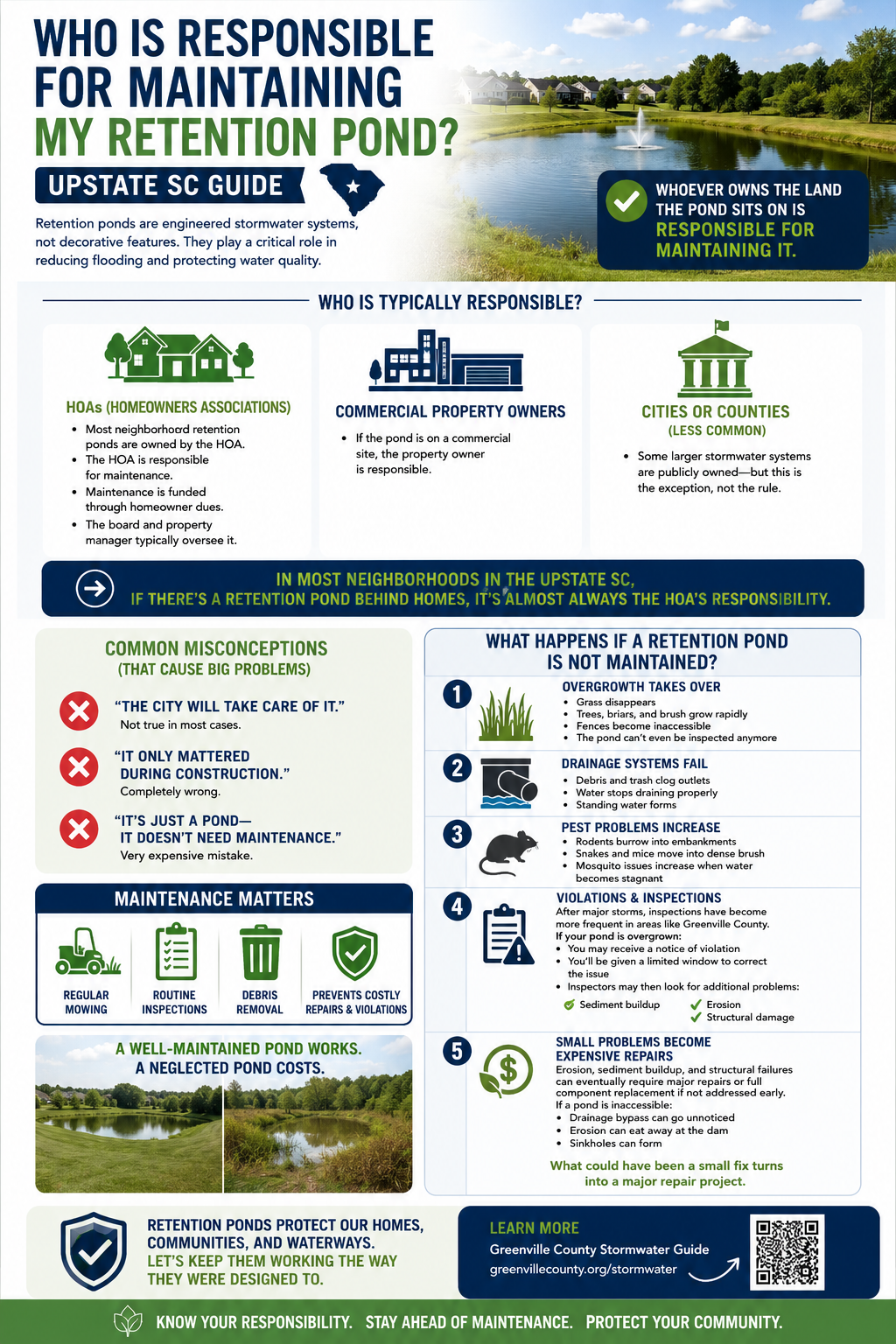
The Short Answer: It Depends on Who Owns the Land
A retention pond is not just “there”—it belongs to someone.
Whoever owns the land the pond sits on is responsible for maintaining it.
In real-world scenarios, that usually means:
- HOAs (Homeowners Associations)
Most neighborhood retention ponds are owned by the HOA. That means:- The HOA is responsible for maintenance
- Maintenance is funded through homeowner dues
- The board and property manager typically oversee it
- Commercial Property Owners
If the pond is on a commercial site, the property owner is responsible. - Cities or Counties (less common)
Some larger stormwater systems are publicly owned—but this is the exception, not the rule.
👉 In most neighborhoods in the Upstate SC, if there’s a retention pond behind homes, it’s almost always the HOA’s responsibility.
The Greenville County stormwater guide reinforces this by requiring that every system clearly identify “the party responsible for performing the maintenance tasks.”
Common Misconceptions (That Cause Big Problems)
One of the biggest issues is not knowing the responsibility in the first place.
Here are the most common misunderstandings:
- “The city will take care of it.” → ❌ Not true in most cases
- “It only mattered during construction.” → ❌ Completely wrong
- “It’s just a pond—it doesn’t need maintenance.” → ❌ Very expensive mistake
Many retention ponds are hidden behind homes or tree lines, so they’re out of sight—and out of mind. But they are engineered stormwater systems, not decorative features.
According to Greenville County guidance, these systems (BMPs) are designed to reduce flooding and protect water quality—and only function properly when maintained.
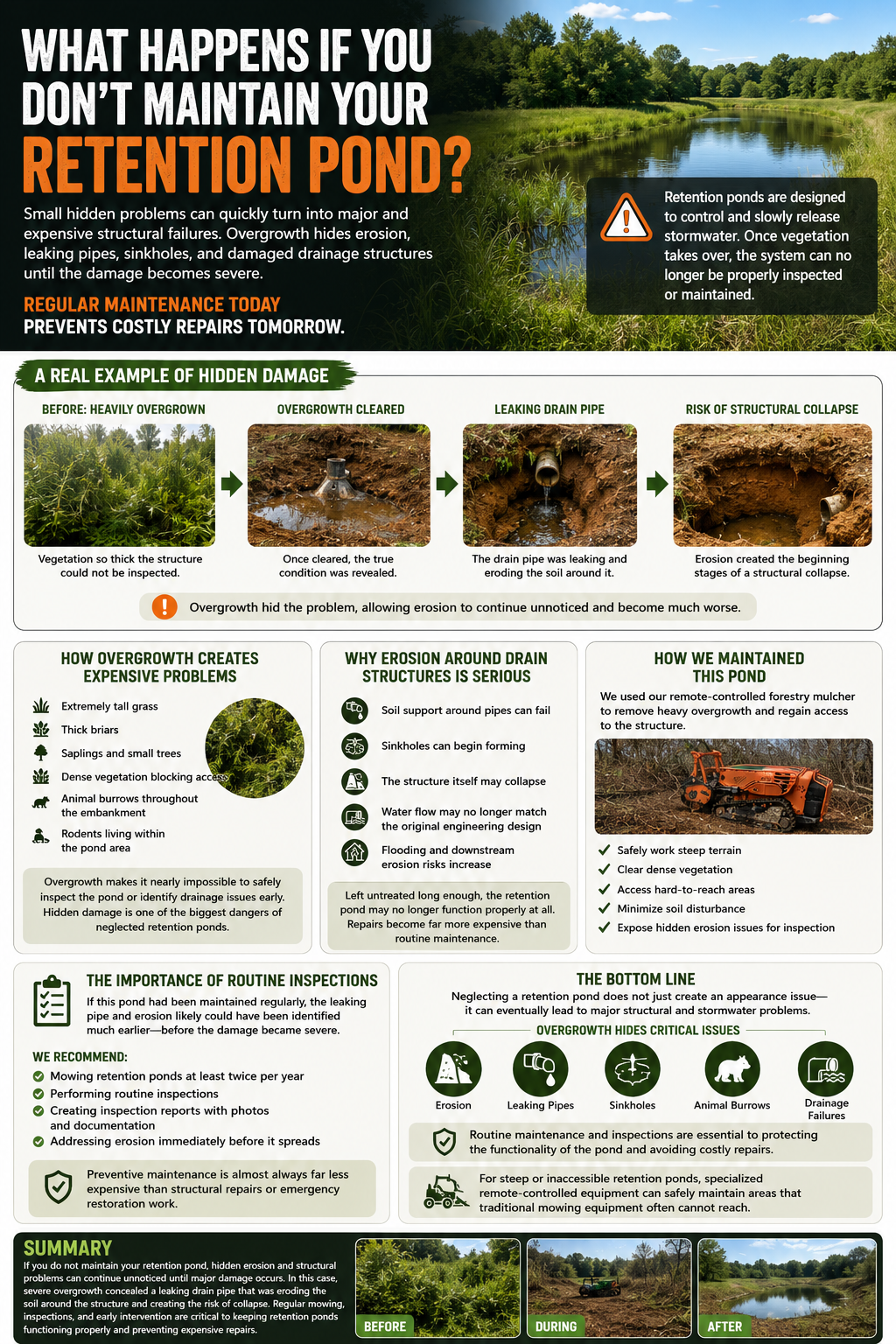
What Happens If a Retention Pond Is NOT Maintained?
This is where things get serious.
From real-world experience in the Upstate, here’s what actually happens:
1. Overgrowth Takes Over
- Grass disappears
- Trees, briars, and brush grow rapidly
- Fences become inaccessible
- The pond can’t even be inspected anymore
2. Drainage Systems Fail
- Debris and trash clog outlets
- Water stops draining properly
- Standing water forms
3. Pest Problems Increase
- Rodents burrow into embankments
- Snakes and mice move into dense brush
- Mosquito issues increase when water becomes stagnant
4. Violations & Inspections
After major storms, inspections have become more frequent in areas like Greenville County.
If your pond is overgrown:
- You may receive a notice of violation
- You’ll be given a limited window to correct the issue
- Inspectors may then look for additional problems:
- Sediment buildup
- Erosion
- Structural damage
5. Small Problems Become Expensive Repairs
One of the biggest risks is hidden damage.
The county guide notes that erosion, sediment buildup, and structural failures can eventually require major repairs or full component replacement if not addressed early.
If a pond is inaccessible:
- Drainage bypass can go unnoticed
- Erosion can eat away at the dam
- Sinkholes can form
What could have been a small fix turns into a major repair project.

Leave A Comment