
Removing Massive Wisteria Vines From a 100-Foot Maple Tree in Taylors, SC
Wisteria can look beautiful when it is maintained, but when it escapes into wooded areas and mature trees, it can become a serious problem.
We recently tackled an extreme example behind a commercial property in Taylors, South Carolina, where a maple tree more than 100 feet tall had become almost completely engulfed by mature wisteria.
These weren’t small vines. Some of the wisteria vines had grown to more than six inches in diameter, with numerous large vines climbing the trunk and extending high into the canopy.
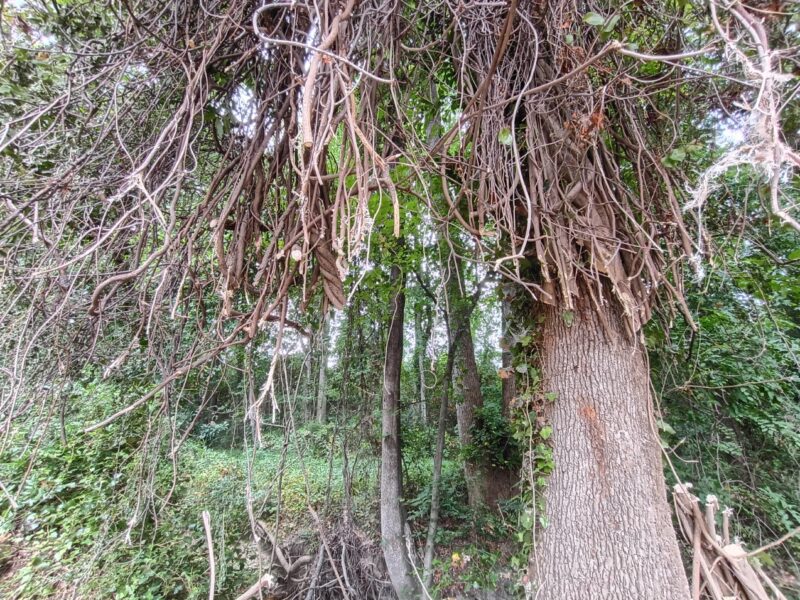
Before removal: Mature wisteria vines had completely overtaken this large maple tree, with some vines exceeding six inches in diameter.
Can Wisteria Damage or Kill a Large Tree?
Yes. Although a large, established tree may tolerate vines for some time, mature wisteria can eventually become a serious threat.
Wisteria is an aggressive, fast-growing vine. Once it reaches a tree, it uses the trunk and branches as a structure to climb toward sunlight. Over the years, the vines can become extremely large and heavy.
In this case, the wisteria had reached virtually the entire canopy of this 100+ foot maple.
That creates several potential problems.
The vines add significant additional weight to branches and the tree canopy. They can also cover and shade portions of the tree’s foliage, compete for resources, and wrap tightly around limbs and trunks.
During severe weather, that additional vegetation can become an even bigger concern. A canopy filled with vines presents more surface area to wind, while rain and ice can add even more weight. Branches that are already stressed may therefore be more susceptible to breaking during storms.
Allowing the vines to continue growing year after year only makes removal more difficult.
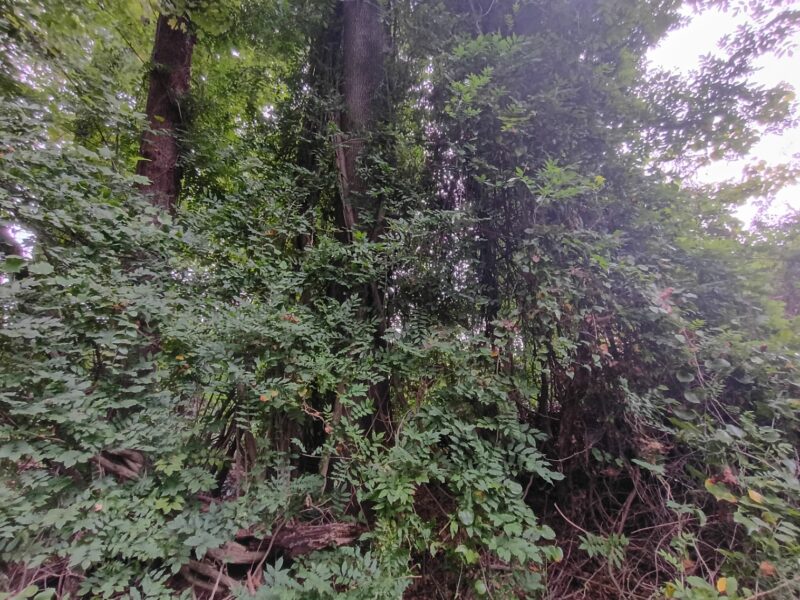
Before clearing: Dense brush and mature wisteria completely surrounded the maple tree, making the trunk difficult to even access.
Getting Access to the Tree
One of the first challenges on this project wasn’t actually the tree—it was getting to it.
The area surrounding the maple had become heavily overgrown with brush and vegetation. Before we could safely work around the tree, we used our forestry mulching equipment to clear the surrounding vegetation and create access.
Forestry mulching allowed us to reduce the heavy growth around the tree while keeping the work concentrated in the overgrown area.
Once the surrounding vegetation was cleared, we could finally see just how extensive the wisteria infestation had become.
Cutting Wisteria Vines Around the Tree
Rather than trying to pull enormous live vines out of a 100-foot tree, we focused on severing the vines from their root system.
We cut every accessible wisteria vine around the tree and removed the vine material from the trunk from ground level to approximately six feet high.
Some of the individual vines were more than six inches thick.
Cutting the vines at the base interrupts the connection between the roots and the portions growing throughout the canopy. The remaining vines higher in the tree can then die back rather than continuing to grow and add new vegetation.
Trying to forcibly pull large vines from high in a mature tree can create additional hazards. Large vines can be intertwined with branches, and pulling on them can potentially dislodge dead limbs or other material overhead.
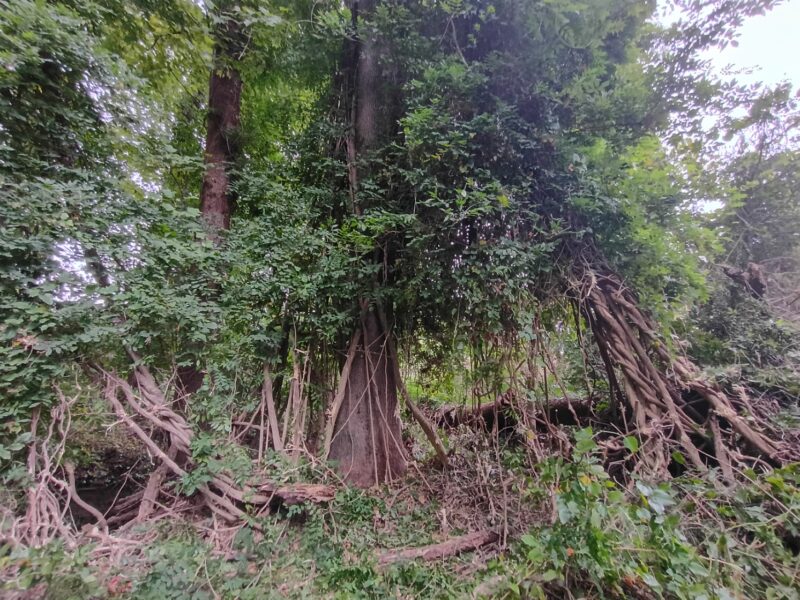
In progress: Smaller vines and surrounding vegetation had to be removed first to reach the massive mature wisteria wrapped around the maple tree.
Why Cutting Wisteria Once May Not Be the End of the Problem
One important thing homeowners should understand is that cutting mature wisteria does not necessarily kill the root system.
On this particular project, the roots were not chemically treated. That means the area will need to be monitored for new growth.
Established wisteria can have an extensive root system and may send up new shoots after the original vines are cut. Follow-up cutting, mowing, or an appropriate targeted treatment may be necessary to bring a severe infestation under long-term control.
This is one reason we recommend dealing with invasive vines before they reach this size.
A small vine growing at the base of a tree is much easier to address than a six-inch vine that has spent years climbing 100 feet into the canopy.
The Difference After Clearing
Once the surrounding brush was mulched and the large vines were cut away from the lower portion of the maple, the difference was dramatic.
For the first time in years, the actual trunk of the tree was clearly visible and the mature wisteria was disconnected from its root system.
The vines remaining high in the canopy will take time to die back and deteriorate. This is not an instant process, particularly with vines of this size.
The important first step was stopping their continued growth.
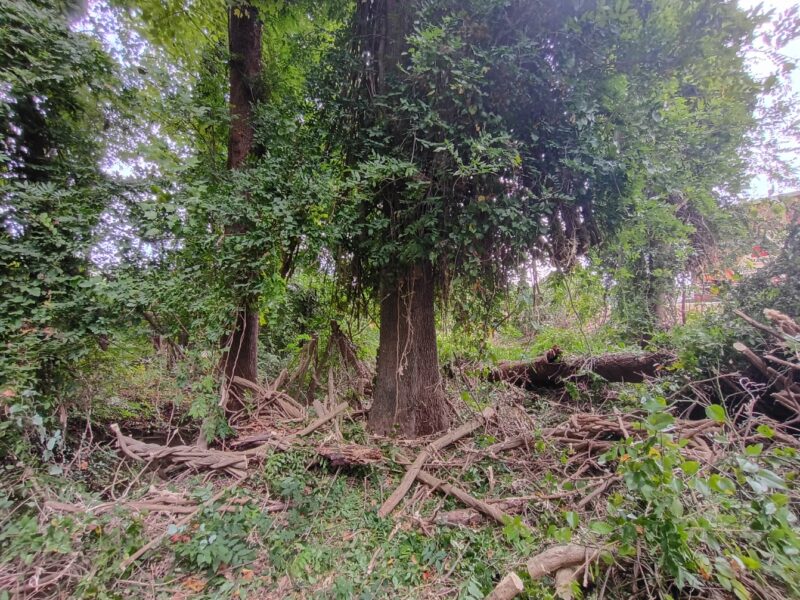
After removal: The massive wisteria vines were cut and removed from the lower portion of the maple, stopping their continued growth into the canopy.
Do You Have Wisteria Taking Over Your Trees?
If you see wisteria or other aggressive vines beginning to climb mature trees on your property, don’t wait until they look like this.
What starts as a few small vines can eventually become a massive network of woody vegetation extending throughout the tree canopy.
Early removal is typically much easier. However, even heavily overgrown properties can often be brought back under control with the right equipment and approach.
MaxSlope Mowing & Mulching provides invasive vine removal, brush clearing, forestry mulching, and difficult vegetation management throughout Taylors, Greer, Greenville, and surrounding areas of Upstate South Carolina.
If you have trees being overtaken by wisteria, kudzu, or other heavy vines, contact MaxSlope to have the property evaluated before the vegetation becomes an even bigger problem.

Leave A Comment